Wednesday, 3 December 2014

The Book Thief: A protagonist in an antagonistic world ( WARNING: SPOILERS)

The Book Thief (2014) film adaptation of the book written by Markus Zusak, is based in Germany during the 2nd World War, and is set on a street called Himmel Street, Himmel translates as Heaven. Which is filled with irony as the book and film are narrated and told from Death's perspective. The story follows the life of Liesel Meminger who is entrusted to the care of Hans and Rosa Hubermann after her mother (who is revealed to be a communist) has to give up Liesel in order to protect her from the Nazi party and Heir Hitler. The film is filled with many dramatic ironies which Death at times vocalises such as:

"I've seen so many young men over the years who think they're running at other young men. They are not, they're running at me."(Zusak:2006)

Throughout the film the audience creates relationships with the different characters, you come to love the residents of Himmel Street that are depicted in the film and you are allowed an insight in to understanding that not all members of the Nazi party were radical extremists, but that many joined the Nazi party in order to survive, which is shown through the character of Hans who is short of work due to his not being a member of the party.

The film ends tragically with Himmel Street being bombed and only Liesel and Rudy's father survive. Death talks rather lovingly about collecting each of their souls, and what is a credit to the construction of the film is that you do not come to hate Death, Death is not the enemy, rather the soldiers who were ordered to drop the bombs are the enemy. And this is where for me a slightly paradoxical event occurs. The airmen that dropped the bombs were most likely British, or someone fighting on the opposing side to Germany. For me being someone who has been taught about the 2nd World War, from an English perspective it is difficult to realise that the winning side also had to take civilian lives in the fight for victory. This leads to, the idea that protagonist and antagonist are broad definitions when you compare the film world (which is based on true events) and the real world. This then opens up the question as to how we justify violent acts, I think that this leads to looking at 3 key areas;

1. The world that the film/book creates
2. The audience member watching
3. The violence that occurs.

These 3 things are forever changing and varying. Violence in the media is not decided by a judge and jury as to the justification of the act but by the audience who watch. Meaning in my view that fictional media violence justification is not blind justice but circumstantial.


Wednesday, 26 November 2014

It's Ok they still got what they deserved Session Notes 26/11/14


Media forms and institutions and their signs, codes and systems along with awareness of culture, context and audiences can reveal alot about the medias engagement with FMV.

Macro Textual analysis 
Tone
Spectacle 
Realism 
Narrative
Genre

The Representation of FMV 

1. However 'realistic' they look media images are never directly present the world = constructed re-presentation of world.

2. Media represent certain situations, stories again and again = naturalising them. 

3. Some images, situations stories presented in limited/oppressive, 'types', 'othering', 'stereotypes'.

Acceptable Media Violence (Carter and Weaver 2005:68)

"...'acceptable' film violence performs a social role in communicating the legitimate right to be violent and who does not, who should fear violence and who should not."

FMV is not 'just' entertainment, it is ideological, our engagement with it is negotiated based on our dispositions. 

Victim Triangle
1. Victim (innocent, helpless)
2. Victimiser (immoral, unjustified)
3. Rescuer (Legitimate, justified)

Context (moral, social, political)
-Mercy or forgiveness to victimiser 
-Construct normative media Violence 

Constructed Impression of Realism (King 2004)

1. Claims status of Actuality 
e.g. Based on a true story or main character has the same name as a real person. Henry Potrait of a serial killer, Henry has the same name as a real serial killer in America. 

2. Emphasis: Performative Realism 
e.g. someone gets punched they go down in real life, however in fictional violence people are beaten senseless yet get up and act as if they were touched by a feather. 

3. Representational codes/conventions of realism, camera, sound, editing e.g. Man Bites Dog is filmed on a 16mm camera conventional of a home movie or self shoot. 

4. Alignment to realist modes of film making 

Non-Serious Modality (King 2004) 

Tendency = Palatable, detached, entertaining 
1. Spectacle (heavy stylised) 
2. Generic Conventions (part of anticipated repertoire) 
3. Comedy (satire, slapstick, dark)

Mixing Modalities
The balance of 'operative' modalities can shift from moment to moment in media texts, the two modalities are not always mutually exclusive. 

Spectacle and Narrative (Leo Charney 2001)

Narrative
Narrative Continuity 
Realism 
Linearity 
Cause and Effect 
Story/Plot/Character

Spectacle 
Spectacular moments
Attractions
Violent Shocks
Sensation/Affect
Formalism


Peoples perception of fear: The Conjuring

The Conjuring 2013 directed by James Wan, depicts the story of two people Ed and Lorraine Warren, who are paranormal investigators.

The film follows the story of a family who find themselves living on cursed land, where a witch who owned the land swore vengeance on all future residents after she failed to kill her child, she possess the mothers to kill the children in order to conjure conduit spirits to come from hell in to the world of the living.

The film in itself does not have scenes that are filled with gore but it very tells a story. I have found that with some horror films/ psychological thrillers tend to show extremely violent acts but fail to create a story, or a sense of realism. The Conjuring creates both. The fact that Ed and Lorraine Warren were real people who investigated paranormal events. It establishes a sense of realism, that makes the events very believable and instills a sense of fear that, it is possible, for the events that happened to this family can happen to you, they are not impossible. Even though the debate exists as to whether or not ghosts and the paranormal even exist, these rely strongly on what people believe.
I did a small study to see how this effect the fear created by films like the Conjuring effect and influence the people that watch them. I asked two questions.

The first was

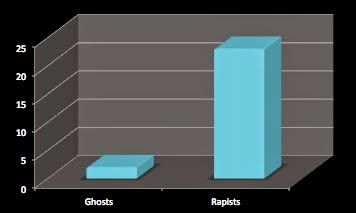
What do you fear more rapists or ghosts?


What do you fear more in a film context rapists or ghosts?


Out of the people that I asked, in a real world context they stated that they were more afraid of rapists than ghosts, due to reasons such as;
-the people asked did not believe in ghosts
-that (especially with the people I asked who were female) they fear those who they do not know and are aware that anyone can attack you
-For those who do believe that ghosts exist, these particular people also believe that they cannot hurt you and share the belief: Don't fear the dead, fear the living.

However as the results show when asked in a film context what do you fear most Rapists or ghosts?
Most answered ghosts, the reasons that they gave were ones such as;
-In films ghosts are harder to fight, as in a film a rapist is human and can be stopped by being; arrested, or even killed. Where as the most common solution to stopping Ghosts are exorcisms, which are harder to perform and like in the Conjuring are shown to not always work.
-Ghosts are not visible and can attack you from anywhere
-Ghosts are shown to be departed, lost spirits who will go to any length to reach their goal.

For those who said that they were still more afraid of Rapists than ghosts gave reasons such as;
-Even though the film is fictitious the film depicts that something that can happen in real life.

Films like The Conjuring work on fears that make us very afraid when we watch films however films based on the paranormal allow us a certain safety blanket when watching them, in the belief that as much as a sense of realism is created many people who watch these films do not proclaim to have seen ghosts, and do not believe that ghosts can harm them in real life. Where as rapists can hurt them in real life and in films that depict sexual violence, tend to test peoples boundaries when watching these films, as well as making people more paranoid as to the fact that rapists do exist.

The Consumption and Risk of Fictional Media Violence: Session Notes 19/11/2014

What pleasures and anxieties do you associate with your consumption of FMV?

Genre Relative to Likes
Action - The more destruction ad fighting the better.
Horror- Some gore is too much but some is watchable.
Psychological thriller- violence that mentally confuses you.

What constitutes justified violence?

Victim, Hero, Villain
Can teach us what society feels about fictional violence.
Anticipation of violence built up as enjoyable.
Anxiety over the possibility of the violent act happening to them.
Realism with in horror movies/ FMV has a rather big impact on how the audience react to what they're watching.
Debate around on of the main drivers as to why people watch things that happen to people in a film/ fictitious world. People can be ethical about those who watch these types of things.

Thinking and Feeling 

Thinking

Ethical                                 Cognitive and Attitudinal
Political                               Ethical and Moral
Ideological                           Ideological and political, social, cultural and economic.

Feeling

Skin                                     Affective and sensation
Muscles                               Multi-sensory
Visceral                               Physiological
                                            Emotional and Visceral
                                            Embodied and Bodily

What are your boundaries and thresholds with respect to your consumption of FMV?

- Rape
- Eyes
- Heels
- Pulling things out of eyes
- Genitals

Risk Thermostat ( Hill 1999)

-Everyone takes risks
-Risk interactive phenomena
-Balance Potential risk and benefits
-Watching violence = Risk activity
- But watching violence = voluntary
- Thermostats set to certain levels depending on individual

Boundary testing and self censorship (Hill, A 97) 

-Threshold types and contexts of violence, viewers find disturbing can be social ( collective) or personal ( subjective)
-Self censorship methods used to watch or not watch violence, i.e. physical/ mental barriers.

What are connotations of these words?

Effect- Fear of being scared
Risk- The understanding of the effect that will occur when watching violence
Influence-issues with people repeating acts in real life.
Harm-long lasting, lingering awareness of fear.

The debates that are linked with these worlds, have shifted in some respects from Effect to Influence. Relationship between texts and consumers cannot be simply defined. Change from it will definitely have that impact to, it could have that impact which has created a debate between risk and harm.

How impactful is FMV on audiences?
People watching violent acts and committing similar acts in the real world. E.g. James Bulger case, questions at the time were raised as to whether media influences on the killers were the cause of their actions.

Who is the Most Vulnerable (othering and stereotyping) 

People that are deemed to be the most vulnerable when it comes to viewing violence vary from peoples perceptions the most common being;

-Children
-Teenagers

However this then sets these groups in to being stereotyped, a child is not born afraid, fear is learnt. I can be debated that in fearing about how others will react to forms of Fictional Media Violence we can distance ourselves from our own fears concerning FMV and how it influences us.


What is Fictional Media Violence? Lecture Notes 12/11/2014

Defining Fictional Media Violence 

Base Definitions 

1. What is Fictional Media Violence?
Violence that is choreographed in a fictitious world. 

2. How does it differ from real violence?
It is created to look real in the world that it is embedded in. 

3. What is mediated real violence?
e.g. Documentary footage of a fight is mediated but still not real violence. 

4. Do these categories Overlap?
Potentially. 

What is Fictional Media Violence?

How does FMV effect audiences?

Does FMV create the sense that we shouldn't be watching due to links with violence in the real world? 

-A case that is strong for this particular point in my opinion would be the film Man Bites Dog, which is a student film, that is shot in a way to replicate a documentary, which depicts a man who professionally kills people, for the thrill of it. That I think creates some of the biggest possible scenarios where it questions whether or not you should watch the events that are filmed. 

-Over exaggerated violence, that creates a scenario that clearly is fake is not necessarily as questionable. 

- Strong Violence- has an impact upon the narrative 

-Weak Violence- violence that has no impact on the narrative. 

Violence: Oxford English Dictionary 

"1. Behaviour involving physical force intended to hurt, damage, or kill someone or something."
"2. Strength of emotion or of a destructive natural force."

-Subjective Violence, person on person violence.
-Ignores objective violence- real violence is the causes of the definition. Fail to look at the context that lead to those actions, e.g. events that lead to the London Riots. 

Most media representations work more in the realms of subjective violence. 

Mediated Real Violence 

-Real Violence Mediated through media institutions and their production processes e.g. TV and Newspaper reports which form a distinct media text from actual events. Texts designed to inform, educate and entertain and can sell brands/ products, e.g. Ebola Documentary: real incident, real world but invited to see it in a particular setting. 

- Real Violence thats been recorded/ documented and remediated via the web and social media. 
e.g. Combat images/ video, Execution video/ images/ CCTV.
These are designed to inform, educate and entertain, and are becoming more common. 

Fictional Media Violence 

- 'Fictional' representations of violence that have been created by media producers/ institutions.
- Texts operate across platforms and employ formal/thematic codes. 
-Texts are designed as entertainments and are marketed and often sold to audiences. 

Narrow and Broad Definitions of Media Violence (Potter 1999) (Method: Textual Analysis) 

Narrow Definition 
Serious Physical assaults 
Beating, stabbing, mutilation, Murder 

Broad Definition 
Threatening Behaviour 
Antisocial Behaviour 
Swearing, threatening 
Agression, Intimidation


Tuesday, 18 November 2014

Captain America: The Winter Soldier Fight Scene

I found that the Captain America: The Winter Soldier, was a far better film than the first Captain America,
it felt slightly more thought through, whilst at the same time making important links to the first film, which helped to aid the story and connect both past and present. One of my favourite parts of the film is when Captain America, and the Winter Soldier have a fight under a bridge, this fight I find to be very well choreographed, particularly the part where the Winter Soldier, is attempting to stab Captain America, and as he wields the knife he seems to masterfully anticipate not only where the knife will fall but how to go one step further and move the knife to attempt to get the best hit. Of course Captain America being the protagonist of this story, is able to win the fight to an extent and avoid being killed once again. Fight sequences like this, are not what I would call grotesque violence, they look like real, plausible fights that could exist, however it is not something that you recoil from, more keep watching in the hope that the hero isn't fatally stabbed by the villain. I find that these fight sequences intrigue audiences to continue watching, and to proceed to cheer for the hero.


Call of Duty: Modern Warfare 2 Airport Massacre

When I first started playing Call of Duty, I spent most of my game playing time on the Multiplayer section of the game, which enabled me to talk to my friends whilst shooting randomly assigned enemies.

But several of my friends recommended that I try the Campaign part as well, this I started to do when playing Modern Warfare 2. And all the playing was fine until a section came up that gave me the option to skip it due to graphic scenes of violence, I believed that the violence could be no worse than the rest of the game and so opted not to skip. I did not realise that this particular aspect involves your avatar/ character, entering an airport and shooting civilians with no form of weaponry with fully loaded machine guns. Call of Duty normally in the respect of shooting fictional characters has no reactions from me, it is a game, no more. But for this particular part it had the worst affect on me. I ended up not continuing on the campaign, that did not stop me from playing Multiplayer. But I do find it curious that playing as a soldier and shooting soldiers does not bother me, if anything the more fictional soldiers I kill the higher I rank. But shooting fictional civilians is where I draw the line, this is not a way to dig at the companies that make the Call of Duty games, as I continue to play them now and will continue to play them as I think they are very well constructed games. It is more that for the entire time I have played these games that was the thing that I struggle to watch and play.